
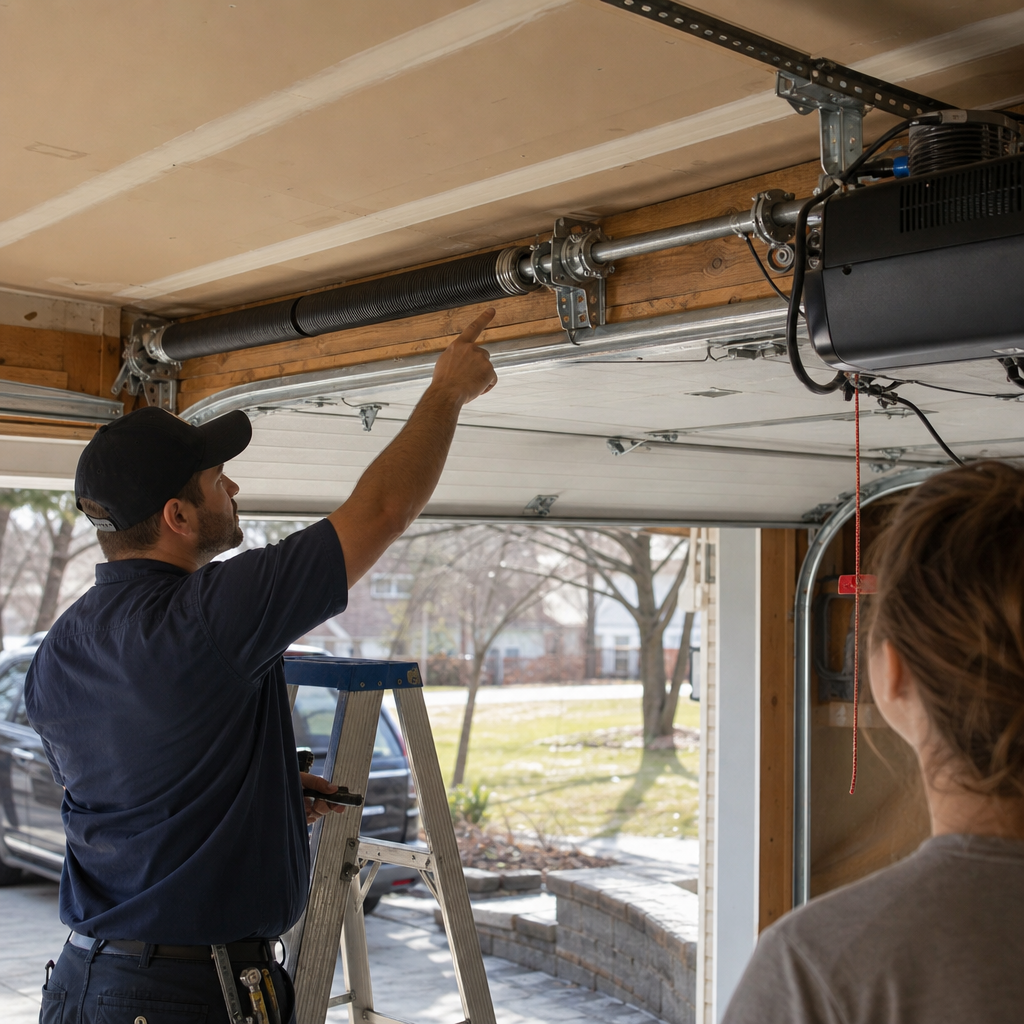
Why Does My Garage Door Reverse in Lowell, MA?
Your garage door reverses because the opener’s safety system detects what it thinks is an obstruction — and in Lowell’s freeze-thaw climate, the most common winter culprit is a frost-heaved concrete floor that shortened your door’s closing distance without anyone touching a setting. The opener hits the raised threshold, interprets the resistance as something blocking the path, and reverses to protect whatever it assumes is underneath. The fix is usually a down-travel limit adjustment, not a sensor cleaning. If you’re seeing this suddenly after the first hard freeze, call Pinnacle Garage Door Installation Lowell at (866) 606-2710 — we can diagnose it in about ten minutes.

Charles Rodriguez grew up in the Centralville neighborhood of Lowell and never really left — he knows these streets, these winters, and exactly what they do to a garage door. He learned the mechanical side of the trade through the Building Trades program at Middlesex Community College in Lowell, where hands-on work clicked for him in a way a classroom lecture never quite did. For over eleven years he’s been the guy Lowell homeowners call for Emergency Garage Door Repair in Lowell, MA when a spring snaps at 7 a.m. or an opener fails mid-January, and he’s built a reputation for diagnosing problems fast and explaining the fix in plain English. Charles still runs every job himself or alongside a small crew he trusts, because he decided early on he’d rather do fewer jobs right than more jobs rushed.
What Changed Between October and January? Your Garage Floor Did
Lowell sits in the Merrimack River valley with no coastal temperature moderation, averaging over 50 inches of snow annually and some of the most frequent freeze-thaw cycles in the region. That cycling doesn’t just snap torsion springs and seize hardware — it heaves concrete garage pads by fractions of an inch, sometimes more. A door that closed smoothly in autumn now meets resistance where it didn’t before, and the opener’s force sensor does exactly what it’s designed to do: reverse.
Here’s what we see repeatedly in Lowell’s older neighborhoods. The Acre, Back Central, and Lower Centralville are packed with pre-1930 triple-deckers and worker tenements where any garage is typically a small detached structure added mid-century with 6’6″–7′ of headroom. These garages weren’t built with modern climate-controlled precision. The concrete pads were poured decades ago, often over minimal or settled base material, and they’ve been through thousands of freeze-thaw cycles. When the ground freezes, it expands; when it thaws, it doesn’t always settle back to the same spot.
The result: your door’s bottom seal now hits a slightly higher surface. The opener’s logic board tracks motor current draw, and when that current spikes — because the door is mechanically stopped by ground contact before the programmed travel limit — the safety reversal triggers. This is not a malfunction. The system is working correctly. The problem is geometry, not electronics.
Adjusting the down-travel limit on your opener unit tells the motor to stop slightly sooner, compensating for the heaved floor. This is a five-minute calibration on a LiftMaster or Chamberlain, a slightly different procedure on Genie or Craftsman units, and something you shouldn’t guess at if you’re not familiar with your specific model’s diagnostic mode. Charles has factory training across eight major brands, so he can access the programming mode on virtually any opener a Lowell homeowner has rather than turning adjustment screws blindly.
How to Tell Floor Heave From Other Causes: A Quick Comparison
Not every reversing door in Lowell is a frost-heave case. Here’s how the symptoms sort out in practice, based on what we’ve diagnosed across 252 service calls:
| Symptom Pattern | Most Likely Cause | What to Check First |
|---|---|---|
| Door reversed suddenly in winter, no one touched settings, closes fine manually | Frost-heaved floor threshold | Measure gap under seal; check for visible pad rise at door edge |
| Door reverses at same spot every time, regardless of season | Misaligned or blocked photo-eye sensors | Clean lenses, check for debris, verify LED alignment lights |
| Door reverses near bottom, seal looks cracked or compressed | Worn bottom weatherstrip adding drag | Inspect seal for hardening, tears, or ice buildup |
| Door reverses intermittently, more often in cold weather | Sensitivity settings drifted on aging opener | Test manual operation for binding; check opener age |
The key distinction with floor heave: the door likely closes smoothly by hand. If you disconnect the opener and run the door manually, it travels full range without binding. That tells you the mechanical system is fine — the opener’s travel parameters just need recalibration for new ground conditions.
The Standard Causes, Ranked by What We Actually See in Lowell
After frost heave, here’s what we encounter most often on garage door repair in Lowell calls:
Misaligned Photo-Eye Sensors
Those infrared beams across your door opening are sensitive to more than just a broom handle. In Lowell’s snow-heavy winters, we regularly find the issue is melting snow or ice debris that dripped down and refroze across the sensor path, or road salt spray that clouded the lenses. The sensors sit 4–6 inches off the floor — exactly where slush gets kicked. One LED flickers or goes dark, and the opener refuses to close.
What we check: Are both sensor housings solidly mounted, not wobbling on stripped brackets? Are the lenses clean, not just wiped but actually clear? Is the beam path interrupted by a shovel, a recycling bin, or a chunk of ice that fell off a tire?
Worn Bottom Weatherstrip
The rubber or vinyl seal along your door’s bottom edge hardens and cracks over time, especially with Lowell’s cold northwest winds channeling through the river valley. A degraded seal doesn’t compress smoothly — it catches, drags, and creates enough resistance to trigger reversal. We’ve seen seals so stiff they actually lift the door slightly off the track at the bottom, creating a bind the opener reads as an obstruction — a problem our Garage Door Off Track Repair in Lowell, MA team handles regularly.
Drifted Sensitivity Settings
Openers have force-limit adjustments that specify how much resistance triggers reversal. On aging units — common in Lowell’s older housing stock where garages were retrofitted decades ago — these settings drift. A 15-year-old Craftsman or Raynor that worked fine in moderate weather now interprets normal cold-weather stiffness as a problem. The fix is recalibration, not replacement, but it requires knowing whether your unit uses analog dials or digital programming.
What You Can Safely Check Yourself — and Where to Stop
We’re not going to walk you through opening your opener’s high-tension spring system or adjusting internal force settings. Those can cause serious injury. But here are three diagnostic steps any homeowner can handle:
- Wipe the photo-eye lenses with a soft cloth and check that both housing LEDs are steady (not flickering). Look for ice, spider webs, or salt residue in the beam path.
- Disconnect the opener (pull the red release handle) and operate the door manually. It should move smoothly through its full range. If it binds or feels heavy, the issue is mechanical — track alignment, roller condition, or spring balance — and that’s pro territory.
- Inspect the bottom seal for visible cracking, hardening, or sections that drag on the floor. In winter, check for ice frozen to the seal itself.
Stop and call when the issue involves the opener’s internal limit or force settings. These are adjusted through the logic board or control panel, and incorrect calibration can disable your safety reversal entirely — creating a genuine hazard if something or someone is under the door. Charles has diagnosed this exact scenario hundreds of times across 11 years in the trade, and he’d rather spend 20 minutes on your opener than see someone get hurt because a YouTube tutorial skipped a step.
If I wouldn’t put it on my own garage, I’m not putting it on yours.
What This Costs to Fix in Lowell
Most reversal issues fall into straightforward repair categories. Here’s what Lowell homeowners typically see:
| Service | Typical Range |
|---|---|
| Opener limit/sensitivity adjustment (diagnostic included) | $120–$320 |
| Photo-eye realignment or replacement | $120–$240 |
| Bottom weatherstrip replacement | $110–$220 |
| Track realignment (if binding detected) | $120–$240 |
| Roller replacement (if manual operation reveals wear) | $110–$220 |
Most reversal calls we handle in Lowell resolve within the garage door repair range of $150–$600. If the opener itself is failing — logic board issues, worn drive gears, or motor problems on units past 12–15 years — replacement becomes the more reliable path. We carry LiftMaster, Chamberlain, and Genie systems for same-day installation when needed.
Why the Safety Reversal Exists — And Why You Don’t Want to Disable It
Every automatic garage door sold since 1993 must include both mechanical and photoelectric reversal systems under federal safety standards. The mechanical system (force sensing) detects contact with an object. The photoelectric system (the eye beams) detects anything in the path before contact. When your door reverses, one of these systems is doing its job.
What we won’t do — what no competent technician should do — is simply crank up the force setting or bypass the photo-eye to “fix” a reversing door. We’ve been called to homes in Belvidere and Centralville where a previous “repair” left the safety systems disabled, and the homeowner didn’t know until a pet or child nearly got hurt. Charles’s approach is always to find why the system thinks there’s an obstruction, then correct that cause. It takes longer than a screwdriver adjustment. It’s also the only way we’d let our own families use that door.
FAQs
The most common cause in Lowell is a frost-heaved garage floor that raised the concrete threshold fractionally, causing the door to meet resistance before the opener’s programmed travel limit — which the force sensor interprets as an obstruction. Other frequent causes include misaligned photo-eye sensors, worn bottom weatherstrip creating drag, or sensitivity settings that have drifted on older openers. Call (866) 606-2710 for a free diagnostic — we’ll identify which system is triggering the reversal and fix the root cause, not just mask the symptom.
Repair is almost always cheaper for reversal issues specifically — most are fixed with a limit adjustment, sensor realignment, or weatherstrip replacement running $120–$320. Replacement becomes the better value when your opener is over 12–15 years old, uses discontinued parts, or has multiple failing components. Charles will tell you straight if a repair isn’t worth the money; we’ve advised replacement on units that were clearly at end-of-life, and we’ve done $150 adjustments on quality openers that had another decade in them. Call for an honest assessment — estimates are free.
Yes — Pinnacle Garage Door Installation Lowell offers emergency service for doors that won’t close or are stuck mid-cycle, and most reversal diagnostics are completed in a single visit. We carry common photo-eye assemblies, weatherstrip profiles, and opener parts for LiftMaster, Chamberlain, Genie, and Craftsman systems. For same-day service in Lowell, call (866) 606-2710.
Check the LED indicator lights on both sensor housings — steady illumination on both sides means the beam is connected; one dark or flickering LED indicates misalignment, blockage, or wiring issues. If both LEDs are steady but the door still reverses, the sensors are likely fine and the cause is elsewhere (floor heave, force settings, or mechanical binding). A quick call to (866) 606-2710 gets you a definitive answer without the guesswork.
When to Call Pinnacle Garage Door Installation Lowell
If your garage door started reversing this winter and you haven’t touched the settings, check the floor first — look for a visible ridge or height change where the door meets the concrete. If you see it, or if you’ve cleaned the sensors and the problem persists, the issue is likely in the opener’s travel calibration. That’s a quick fix in trained hands, but it’s not a DIY project — the force and limit settings interact with your safety systems, and getting them wrong creates real risk.
Charles Rodriguez, Owner & Lead Technician at Pinnacle Garage Door Installation Lowell, brings 11 years of hands-on experience and factory training across eight major brands to every call. With 252 verified reviews averaging 4.9 stars, we’ve built our reputation on showing up, diagnosing accurately, and fixing it right the first time. If you’d rather have it looked at, we offer a no-pressure assessment in Lowell — call (866) 606-2710.
Written by Charles Rodriguez, Owner & Lead Technician at Pinnacle Garage Door Installation Lowell, serving Lowell, MA.